
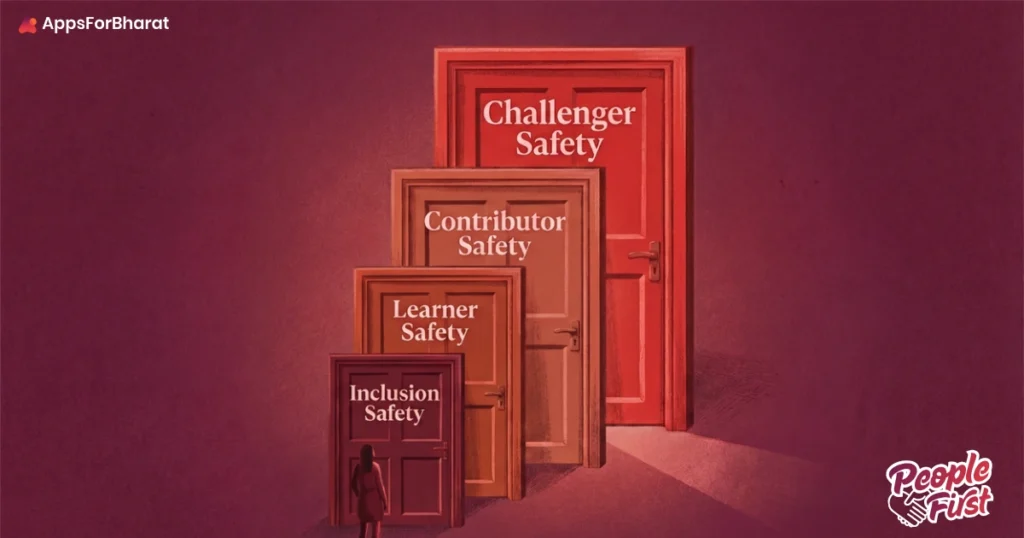
Psychological safety is often spoken about as a feeling…
People should feel safe to speak up. Teams should feel comfortable sharing ideas. Leaders should encourage openness.
All of this is true, and also incomplete.
In a fast-growing startup like AppsForBharat, psychological safety cannot remain an abstract idea. It has to be designed, practiced, and strengthened deliberately. As teams scale, stakes rise, and decisions become harder, culture defaults to systems, not intent.
In the early days of a startup, psychological safety feels effortless. Small teams, informal conversations, proximity to problems, and constant collaboration make it natural to question, disagree, and learn out loud. But as the organization grows, roles formalize, hierarchies emerge, and pressure increases. What once felt safe by default begins to require conscious design.
This is when we realized something important:
Psychological safety is not one thing. It develops in stages, and most organizations stop far too early.
The first stage is inclusion safety. At this level, people are answering a simple question: do I belong here? Inclusion safety exists when people feel respected, accepted, and treated fairly. Without it, silence sets in quickly.
In our recent pulse survey, we asked a foundational question: “Do you feel respected and treated fairly at work?” Close to 90 percent of our employees said yes. This matters because it tells us that, for most people, the foundation is present. They feel a sense of belonging and fairness. But this is only the starting point. A positive response here does not mean psychological safety is complete. It simply means the first door is open.
The second stage is learner safety. This is where people feel safe to ask questions, admit what they do not know, and make mistakes without fear of judgment. In a company like ours, operating at the intersection of faith, technology, and scale, learning never stops. We encourage learner safety by seeing leaders acknowledge gaps openly, by conducting reviews that focus on learning rather than only outcomes, and by treating failures as inputs for better decisions. Still, even strong learner safety has its limits.
The third stage is contributor safety. This is about ownership and agency. People feel trusted to execute, make decisions, and take responsibility without being micromanaged or second-guessed. At AppsForBharat, we learned that clarity creates safety. Clear roles, decision rights, and expectations reduce anxiety far more than reassurance ever could. Yet even high ownership environments can stagnate if assumptions remain unchallenged.
That brings us to the most difficult and most critical stage: challenger safety.
Challenger safety exists when people feel safe questioning decisions, challenging assumptions, and pushing back on leadership without fear of negative consequences. This is not about being contrarian. It is about responsibility. When the cost of silence becomes higher than the discomfort of dissent, challenger safety becomes essential.
We learned that challenger safety does not emerge from saying “feel free to disagree.” It emerges from design. We intentionally create forums where alternative views are invited, decision-making stages where debate is expected, and leadership reviews where thoughtful challenge is valued. Just as importantly, leaders visibly acknowledge when a challenge improves an outcome. That signal travels faster than any policy.
Over time, something shifts. People stop asking whether it is safe to speak up. They start asking whether it is responsible not to.
It is important to be clear about what psychological safety is not:
It is not about being nice. It is not about avoiding discomfort. It is not about lowering standards or chasing consensus. In fact, the highest form of psychological safety often feels uncomfortable. It involves tension, debate, and intellectual honesty grounded in trust and shared purpose.
For us, building products that touch millions of people’s spiritual lives, the cost of unchallenged assumptions is simply too high.
When psychological safety is treated as a perk, it disappears under pressure. When it is treated as an operating system, it scales. It shows up in how meetings are run, how reviews are conducted, how leaders respond under stress, and how disagreement is handled when it matters most.
We are still learning and refining. But one belief is clear to us.
A culture that cannot be challenged will eventually fail its people and its mission. And that is not a risk we are willing to take.